
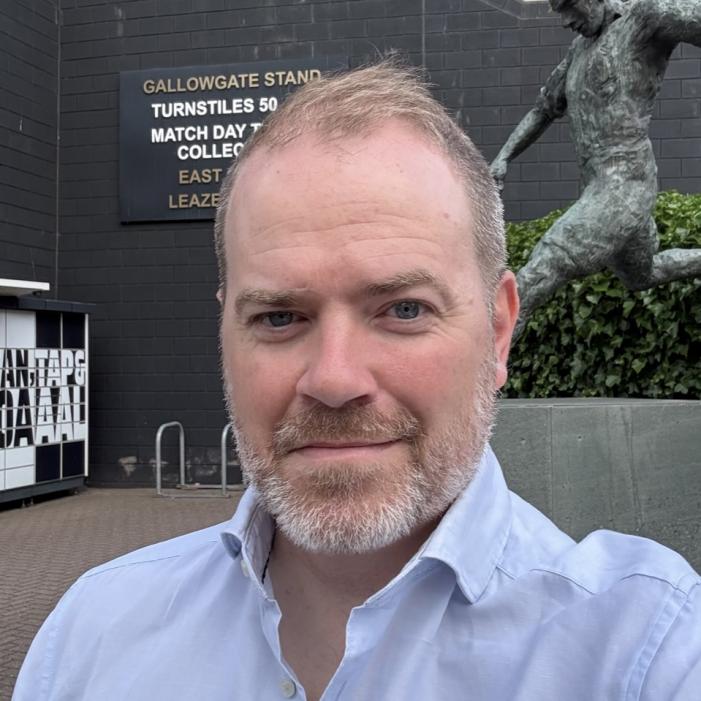
Howay the Lads!: Interview with Dan Jackson
What led you to the subject matter of this book? Was it a progression from your research for The Northumbrians?
Very much so. The Northumbrians was an attempt to understand how the region developed such a strong and distinctive sense of itself: a place shaped by geography, history, industry, religion, language and a certain distance – physical and psychological – from the centres of power in the south. Football was inevitably part of that story, but I felt it deserved a book of its own. What interested me was not simply the history of Newcastle United as a football club, but why the club came to matter quite so much to the people of Tyneside. Why does football occupy such an extraordinary place in our collective life? Why is St James’ Park where it is, looming over the city like the Acropolis? And why have generations continued to invest so much hope in a club which, for much of its modern history, has offered remarkably little tangible rewards?So Howay the Lads grew naturally out of The Northumbrians. In some ways it takes one strand of that earlier book – belonging – and follows it much further. Although it is a history of a football club, but don’t let that put you off! Because it’s really a book about place, identity, memory and what it means to belong to somewhere.
To give us a taste of the book, can you introduce us to how and why you think football defines the character of the North East?
Football is particularly powerful in the North East because it arrived just as the modern region itself was being made. In the late nineteenth and early twentieth centuries Tyneside – as well as Wearside and Teesside – were growing at extraordinary speed, drawing people into rapidly expanding industrial towns and cities. Football gave these new urban communities something around which they could gather and construct a shared identity.There is also something about the particular character of North East football. It has always contained a slightly improbable mixture of pride, defiance, humour, pessimism and hope. And because Newcastle United has won so little for so long, supporting the club became less about celebrating success than demonstrating belonging. The remarkable thing wasn’t that people supported Newcastle when they were winning; it was that 52,000 people continued to turn up when they weren’t.
That is why St James’ Park matters so much too. Its position in the middle of Newcastle makes the relationship between football and place unusually visible. You don’t leave the city to go to the football ground: the football ground is part of the city. In that sense Newcastle United hasn’t simply represented the place. Over more than a century, it has helped the place understand itself.Would you ever shift your focus away from the North East, or is there more you want to research and write about this region?
I am fascinated by this place, and every time I think I should escape the North East, I seem to find something else that opens another door.However, what increasingly interests me is not simply the region’s distinctiveness, but what its history can tell us about Britain more generally. One idea I’m beginning to explore is that for much of the nineteenth and twentieth centuries, places such as Newcastle and Sunderland, but also the boroughs of Gateshead, Tynemouth and South Shields possessed an extraordinary confidence in their ability to govern and improve themselves. You can still see it in the town halls, libraries, parks, baths and other civic buildings they left behind. I worked for ten years in South Shields Town Hall, and that faded grandeur had quite an effect on me. These weren’t places that thought of local government simply as the administration of services; that building embodied a much larger conception of civic life and civic ambition.I’m interested in how we lost that confidence – how power became increasingly concentrated at the centre (i.e. London), how local political life diminished, and what might now be recovered through the renewed interest in devolution. So, although the story would begin in the North East, I think it could become a much broader book about Britain: about the rise, decline and possible rebirth of civic power.Perhaps that’s the progression in all three books. The Northumbrians asks what makes a region; Howay the Lads asks how people express their belonging to it; but my next project might ask whether places like ours can recover the power and confidence to shape their own futures.Which football icon fascinated or surprised you most while writing Howay the Lads
Which football icon fascinated or surprised you most while writing Howay the Lads?
Colin Veitch, without question. One of the most remarkable people in the history of the North East – not just Newcastle United. Not only was he one of the outstanding footballers of his generation, captaining United during their first great period before the First World War, when they won three league titles and appeared in five FA Cup finals, and playing for England. But he was also a talented amateur actor, musician, writer, trade unionist and political activist, with a very strong sense of social justice. He helped establish the Players’ Union, fought on the Western Front and later became one of the founders of the People’s Theatre in Newcastle (and a friend of George Bernard Shaw). He represents a world in which a footballer could be a major civic and cultural figure as well as a sportsman.What fascinates me is how modern he seems. We sometimes imagine Edwardian footballers as rather remote, monochrome figures peering out of from old team photographs, but Veitch emerges so vividly – not least because of his matinee idol good looks! – as a complicated and intellectually curious human being. In some ways he embodies one of the themes of the book: Newcastle United has always been most interesting when you place the football back into the wider life of the city.
Do you think the sort of personalities that we look back on as legends still exist in the sport as media training and sport science increasingly take over? Are there any current or recent players who you think will become those kinds of figures in the future?
They do, although I think it has become harder for us to see them. Modern footballers operate in an extraordinarily controlled, often sterile media environment. Every interview can become a social media controversy within minutes, so clubs understandably media-train players and players learn to protect themselves. The result is that we probably see less of their real personalities than supporters once did.But legends aren’t created simply by being eccentric or quotable. They’re created by the relationship they establish with supporters – and that still happens. At Newcastle, someone like Joelinton is a great example. His transformation from an apparently disastrous record signing into this hugely committed, combative and much-loved figure is already part of NUFC folklore. I would also point to Dan Burn as a modern-day Geordie folk hero because his story feels almost too perfectly Newcastle to be invented: a boyhood supporter from Blyth who laboriously worked his way up from the lower leagues, came home to play for his club and scored at Wembley as Newcastle finally ended their long wait for a domestic trophy. A gangly 6ft 7in centre half, but an immensely effective one, fiercely committed and unmistakably local, he always seems to have a twinkle in his eye, and embodies the mixture of graft, humour, resilience and pride that supporters like to imagine in themselves.
What’s your personal history with NUFC?
I tend to agree with the great Danny Dyer that you don’t choose a football club: football clubs choose you. And like a lot of Newcastle supporters, I can’t really remember making a conscious decision to support the club; that was taken out of my hands by my father, but I was fortunate in the timing of my football education because I then experienced the Keegan years as a young supporter. For anyone who lived through that period, it is difficult to exaggerate the transformation. Newcastle went from being this shabby Second Division club seemingly going nowhere to having Kevin Keegan in charge attracting big crowds, playing exciting, attacking football and building a team capable of challenging for the title. This changed not just the club but the whole mood of the city.So, writing Howay the Lads was partly an attempt to understand my own inheritance. You begin thinking you’re writing the history of a football club and eventually realise you’re writing about families, communities, the city and the strange emotional attachment people develop to a place. This infuriating football club is one of the threads that connects all of those things.
How are you feeling going into the new season for NUFC after the transformative summer they’ve had?
A common theme in the history of Newcastle United supporters is their absurd optimism – “every year they think they’re gonna win the league title, FA Cup, the Grand National and the Boat Race” as Harry Pearson once put it – and I am exactly the same. But I’m most excited by the new manager: a suave alpha male from Baden-Württemberg called Matthias Jaissle who has arrived on Tyneside with a stack of trophies under his belt and the promise of “vertical football”. So, in the words of the Gallowgate’s new favourite chant, “Jaissle! I can boogie…”
Howay the Lads!: Interview with Dan Jackson, by Carys Vickers, New Writing NorthSign Up To Little Crack