
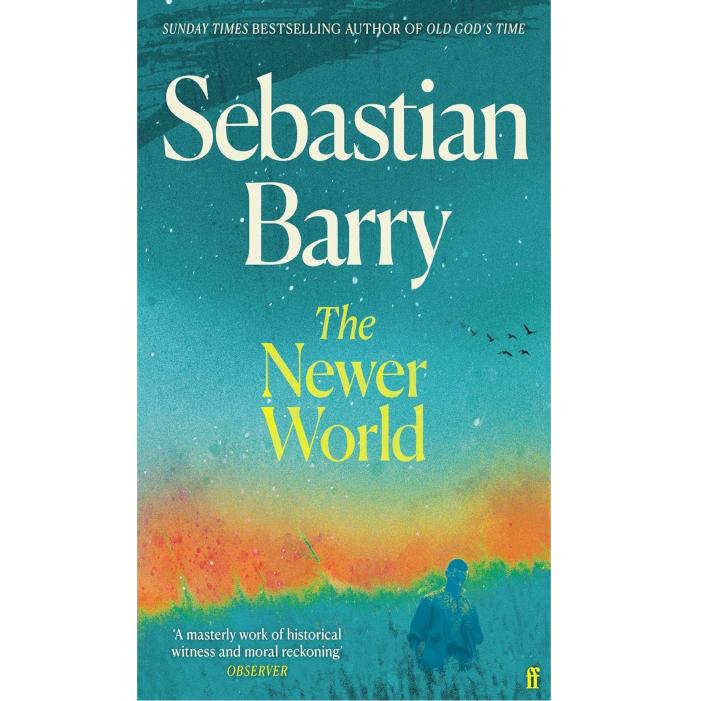
The Newer World by Sebastian Barry
Although slavery officially became illegal in the United States in 1865, prejudice didn’t end. The world for people of colour changed, but it wasn’t a “new world”—a fact acknowledged in the title of Sebastian Barry’s masterful new novel. It’s a tale narrated in late middle age by Tennyson Bouguereau, a man born into slavery in Tennessee alongside his beloved twin sister, Rosalee. Tennyson tells of how the pair grew up on a small tobacco farm, and details the brutalities of slavery and the Civil War. Then, during the post-war era of emancipation, a gang of defeated Confederate rebels attacks the farm. Tennyson steps up to defend it, but is eventually forced to flee. His exile takes him to Nashville where he spends some time with a choir of Black singers under an evangelical minister. The troupe crosses the country, playing to hostile white crowds who are oftentimes won over by the choir’s prowess before sinking back into their old prejudices (“The sea of faces in the audience, the blighted cities and towns, the flea-bitten beds, the raw hatred, then the sudden approval, then the curious waning of it again”). Tennyson experiences love for the first time, and also joins the US Army at camps in the American West. ‘The Newer World’ forms a trilogy with Barry’s previous, much-lauded works ‘Days Without End’ and ‘A Thousand Moons’, and while it does feature some of the characters from those previous novels, it also works as a stand-alone story—a story that is deeply empathetic and brimming with the author’s typically elegiac prose. RM
Faber
Sign Up To Little Crack