
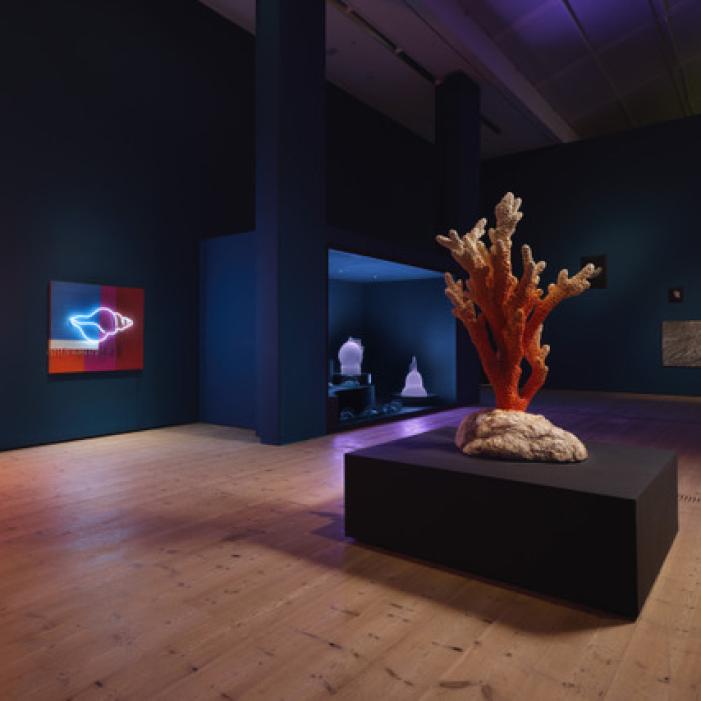
Ocean colour scene
The quotation that provides the title for this immersive, multi-media group exhibition ends “to the sea”, a reminder of origins, the deep connections of tidal rhythms and the sheer power of the environment that covers more than 70% of the Earth’s surface, supporting a vast amount of life, from microbes to marine megafauna. The ocean is vital for our survival, a source of oxygen, food, energy and medicines which also functions to absorb excess carbon from the atmosphere. However, human activities such as the burning of fossil fuels, plastic and chemical pollution and overfishing are degrading marine habitats and pushing many species to the brink of extinction. BALTIC’s new show attempts a thoughtful balance between the ecological message that our relationship with marine waters needs to be realigned, and the sheer, alien beauty of this undersea world, which still holds unmapped deeps and worlds of uncategorised living treasure.
There is a definite tang of salt in the air as the viewer moves through the galleries – a reminder that the real, material borderland between sea and earth is literally just outside the building. Not simply located next to the (tidal) River Tyne, Baltic is built on land that was once salt meadow habitat, eight miles from the North Sea. In the development of the exhibition, the curators engaged in creative conversation with artists but also with marine biologists, oceanographers, researchers and conservationists, and over the course of the next six months the gallery looks forward to hosting a public programme involving talks, workshops, performances and films expanding on the theme of the exhibition. The other world that the show evokes, however, is that of the Aquarium. Darkened rooms are lit by screen/windows into another universe, where surprising colours and luminosity draw our gaze, while flickers of movement remind us that we are viewing shadows and reflections of a fluid medium that teems with life and activity, a rich soup of evolution and adaptation for sheer survival.
The sensory element of sound, not usually associated with a silent, sub-aquatic realm, engages the viewer still further in the videos “Dengung Hyaena” and “Hyena lullaby” (2020) by Taloi Havini and Michael Toisuta. Coral bleaching has become a common sight along reefs throughout the Pacific Ocean as the health of coastal habitat environments is adversely affected by rising sea levels, unpredictable weather patterns and human exploitation of the reef. Yet in all of this devastation, marine nature demonstrates its remarkable capacity for regeneration in a night-time ritual of mass coral-spawning, where lunar patterns are seen to coincide with the coral releasing new life, rising to the surface and floating along before falling back to form new corals along the reef, an annual event celebrated by Havini’s Nakas clan ancestors. The haunting, mythic resonance that this work brings to a natural phenomenon calls up a contrast to the more scientifically directed approach of Rob Smith, a British artist and researcher based in Newcastle upon Tyne. His work explores human relationships with marine environments, and the ways digital technologies can materialise these remote and inaccessible places to develop new, critical understandings and narratives for the deep sea in the context of climate change. He is currently a member of the Norwegian University of Science and Technology (NTNU) research project “Visualising the Deep Sea in the Age of Climate Change” working alongside scientists, historians, and artists to question how technological mediation can affect our relationship with the ocean. Here, he uses digital imaging processes to investigate the recent discovery of ‘dark oxygen’ generated by deep-sea nodules in a new multimedia work with real-time data.
While Joan Jonas’ multimedia installation Moving Off The Land II (2019) pays tribute to ocean life, its biodiversity, intelligence and complex ecologies, Monira Al Qadiri’s Zephyr sculptures (2023) reimagine ancient marine fossils found in desert regions, reminding us that these delicate marine organisms have existed for millions of years, long before our seas receded. On a more disturbing note, Bianca Bondi’s sculptures Red List Hector’s Dolphin (The Fall and Rise) and Red List Amazon River Dolphin (The Fall and Rise) (both 2021) are a poignant reminder that in some regions these charismatic creatures face extinction, which disrupts the nutrient cycle and affects other marine life. The cycle of life, death and rebirth is also the subject of Otobong Nkanga’s woven tapestry Tied to the Other Side (2021), which considers the colonisation of marine frontiers and the loss of life at sea.
Between the poles of myth and technology, marine life and human intervention, unexplored depths and contested coastlines, the exhibition allows its twelve participating artists to produce works that open up a fluid, unscripted dialogue, where focus and viewpoint are in a constant hypnotic, enthralling state of flux.
For All At Last Return, BALTIC, Gateshead, until 7 June, baltic.art
Sign Up To Little Crack