
Small but perfectly formed
Gail-Nina Anderson squints in the direction of ‘Miniature Worlds: Little Landscapes from Thomas Bewick to Beatrix Potter’, which is currently showing at the Laing Art Gallery in Newcastle.
Here’s a handy tip – if the gallery hosting an exhibition with the words ”little” and “miniature” in its title offers you the use of a magnifying glass while viewing the works on show, definitely take them up on it. This is a screwing-up-your-eyes-and-peering-at-embarrassingly-close-range sort of show, so there’s no point in standing back and gazing from a distance in an authoritative sort of manner. Engagement has to be pointedly direct and well-focused, which adds an intensity to the viewer’s individual experience of the material under scrutiny.
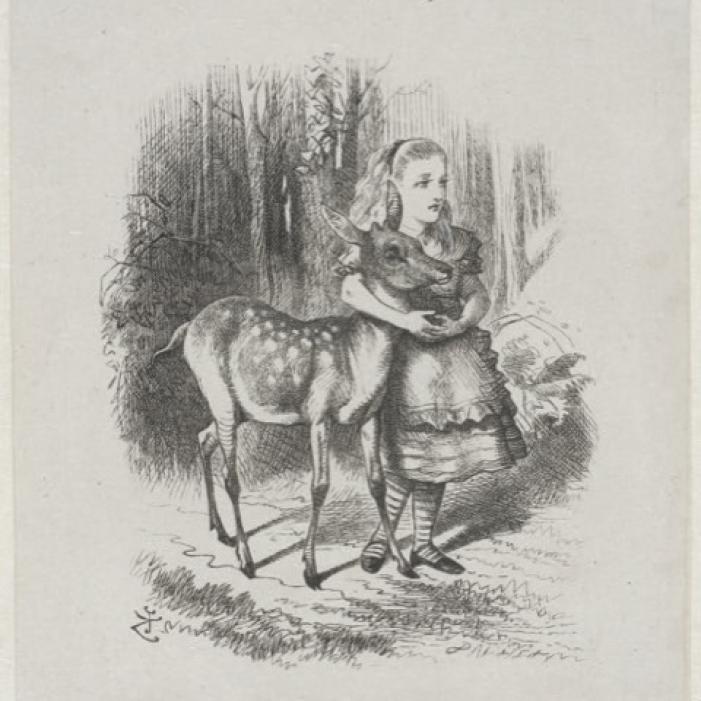
Miniature here doesn’t refer to those minute, jewel-like portraits usually described by that term, but instead demonstrates the peculiar power of condensing landscape elements into an unexpectedly tiny format. In some cases this involves a close-up view of features that are naturally small in scale, suitable (in the work of Beatrix Potter) for the world of Tom Kitten or Mrs Tittlemouse. There’s also the associated idea that little hands like little books, hence some irresistibly twee nursery volumes illustrated by Kate Greenaway and engravings of Tenniel’s original illustrations to “Through the Looking Glass and What Alice Found There” (1871). At the other end of the concept, however, there are painted and engraved landscapes that would be enormous in nature but are here scaled down to diminutive representations the size of a greetings card. It’s fascinating to see what artists have chosen to leave in/out in this process, sometimes miniaturising details with linear (if eye-watering) precision, sometimes going instead for sweeping effects where atmosphere holds together a simplified version of the natural scene. It’s rather astonishing to find a version of John Martin’s “Marcus Curtius”, an epic urban scene of martial heroism that might fill an entire wall if the artist hadn’t miniaturised it to its component parts, all rushing lines, sweeping gestures and dramatic flashes of lightning. The six watercolours by Turner might stand as an object lesson in “less is more”, encapsulating depth and distance, the water and air between, the sense of a human presence giving way to immeasurable immensities of mountain and sky, and all accomplished on discreetly small sheets of paper, suitable to sit on a writing desk. They prompt us to consider how Turner, like Martin, demonstrated that scale and size are not the same thing. The translation of Turner’s painted scenes into engraved illustrations is a reminder that many of these works were designed to be viewed in the pages of a book held in the hand and thus to be read in their relationship to text and margins, which is why they are often in vignette form, unconfined by a border and simply ceding the edge of the image to the blank surrounding paper.
Which of course brings us to that local master of the tiny (yet somehow immense) wood engraving, Thomas Bewick. Black and white and linear, his scenes punctuate the pages with tiny glimpses not just of landscape but of humanity at home in it, a Lilliputian encapsulation of an inhabited world. Personal (seasonal) favourite must be the children building a snowman, complete with wig-wearing head and smoking a pipe. An inscription translates as “May it endure” but we know that snow, smoke and childhood are all transient things.
Bewick certainly knew what game he was playing – one minute rural scene is almost totally obscured by a (painstakingly engraved) thumb-print, a quirky gesture that feels disconcertingly modern. This detail gets referenced in one of Paul Coldwell’s recent sculptures related to the epic last voyage of Captain Scott, as the second gallery explores the ways contemporary artists have taken on the challenge of the small. Here I particularly liked Joanna Whittle’s “Forest Shrine, With Saints, With Mountains”, a fantastic Leonardesque vista painted in oil on a postcard in 2022, yet creating across the centuries a dialogue of spatial arrangement with the graceful artificiality of the 1774 “River Landscape seen through Trees” watercolour by William Beilby. A viewers’ favourite will doubtless be the long folded paper tunnel view of Brighton Chain Pier (anonymous, 1829). The trick here is that you view the entire length of the Pier like a peep-show, through an opening at one end – though you’ll have to bend double to achieve this. And from the faintly ridiculous to the sublime – in his minute wood engraving “An Explorer”, an illustration to Martin Armstrong’s “Fifty-Four Conceits” (1933) master print-maker Eric Ravilious manages to make this rocky landscape with stars, one of the smallest images on display, into something awesomely cosmic in scope. Size and scale, like medium and handling, are clearly central to the artist’s concept and to the impact of the finished image.
Miniature Worlds: Little Landscapes from Thomas Bewick to Beatrix Potter, Laing Art Gallery, Newcastle, until 28 February 2026, northeastmuseums.org.uk/laing

Sign Up To Little Crack